An undersized PSU causes cards to drop and systems to reboot; an adequately sized one still raises questions of redundancy and certification. How to calculate GPU system power, when 1+1 redundancy is worth it, and which certifications export projects must check.
The power supply is the most underestimated component in a GPU system. CPU and GPU specs get compared line by line, while the PSU is often an afterthought — until assembly day reveals missing connectors or insufficient capacity. GPU systems have steep transient power curves: a PSU that is too small causes cards to drop and reboots, and even a correctly sized one raises questions of redundancy and certification. This article covers three key points.
【How to calculate capacity】
The basic formula: CPU peak TDP, plus per-GPU power times card count, plus drive power times drive count, plus fans and motherboard peripherals — then add 20–30% headroom. Three items are easy to miss: NVMe drives draw real power at full read/write speed; simultaneous GPU boost across many cards can exceed nominal TDP; and temperature-controlled fans at full speed add tens of watts.
For an eight-card system: eight 300W cards plus dual-socket CPUs push peak system draw well past 3000W, so the PSU should be sized from a 2000W-plus redundant configuration upward.
【Single PSU or 1+1 redundant】
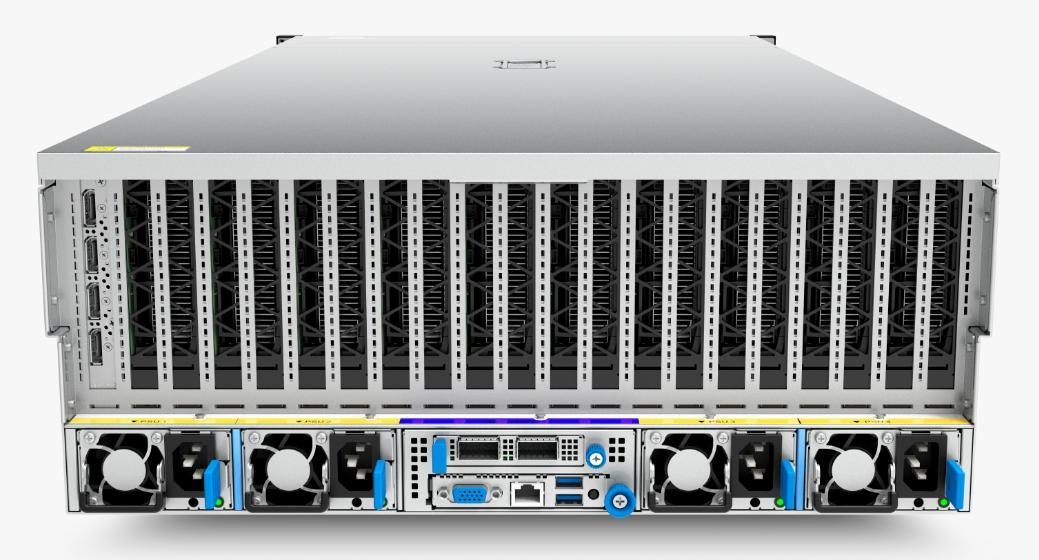
A single PSU is simple and inexpensive, right for test machines and internal compute nodes. For systems that serve external users or run tasks that cannot be interrupted, choose 1+1 redundancy: two modules each carry half the load, and if one fails the other takes over instantly with no downtime while the failed module is hot-swapped. Storage chassis commonly offer both single and 1+1 redundant configurations — decide before ordering.
【Certification and voltage】
Export and externally operated projects should check three items: an 80PLUS efficiency rating (Gold or Platinum tiers affect long-term electricity cost); CE / FCC safety certifications; and voltage format — overseas sites often mix 110V and 220V supply, where wide-range input and active PFC are baseline requirements. All of these appear in the chassis spec sheet; confirm them in the quote so the system passes local acceptance after arrival.
【Matching the chassis】
A PSU is never chosen in isolation — it must line up with the chassis: ATX or CRPS redundant module format; whether chassis depth accommodates PSU length; whether the PSU fan direction matches the system airflow; and whether the front panel has a power-alert LED so a failed redundant module is visible at a glance in the rack. GPU chassis model suffixes often encode the power configuration (such as the CR412-850-GS / 880-G series). Send us the GPU model, drive count, and motherboard together, and we will work out the power budget directly.