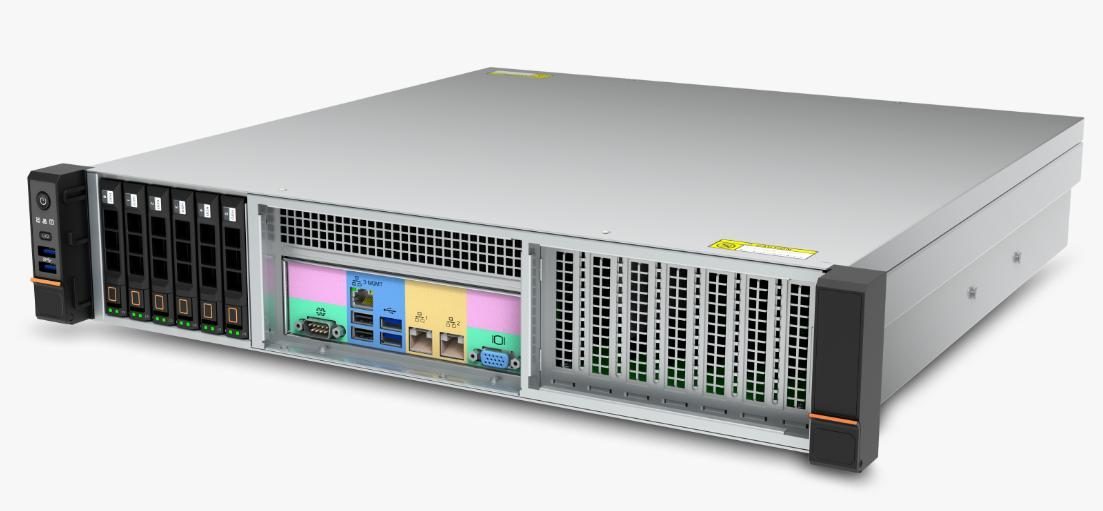
Built for space-constrained edge nodes: 2U short-depth body, half-width and Mini-ITX motherboard support, reserved expansion and airflow — now open for low-volume prototyping.
Many edge-deployment projects hit the same wall: the "server room" is not a room — it is a cabinet, a wall-mount rack, or a control enclosure on a production line. Standard-depth server chassis simply do not fit, and tower systems take up too much room. We built a 2U short-depth edge chassis for exactly these space-constrained scenarios, and it is now open for low-volume prototyping. This article explains the design intent and who it is for.
【What short depth solves】
Compressing the body depth lets the chassis fit shallow racks, wall-mount enclosures, vehicle and marine cabinets, and production-line control boxes — all scenarios where rack depth falls short of 500 mm and a standard 600 mm-plus chassis cannot enter. Short depth also means lighter shipping and easier on-site installation; edge nodes are usually carried to the site and assembled there, and a smaller body saves effort at every step.
【Motherboard and expansion】
The chassis supports half-width and Mini-ITX motherboards — the 170×170 mm footprint pairs naturally with the short-depth body. PCIe expansion is reserved for the most common edge upgrades: 5G/4G modules, 10GbE NICs, and data-acquisition cards all fit. In a compact enclosure, expansion slots are scarce; this model spends them where edge deployments need them most.
【Thermal design】
Edge environments have poor cooling conditions, so the airflow is purpose-built: a straight-through duct with a fan wall, so heat exits without recirculating. For high-temperature or dusty sites, wide-temperature and fanless variants can be evaluated. The half-width layout keeps the intake face unobstructed by neighboring equipment, so the chassis still breathes in dense racks.
【Prototyping and volume】
Low-volume prototyping is now open with friendly MOQ — start with one to three units for solution validation, then scale up. During prototyping, motherboard model, expansion cards, and PSU configuration can all be verified for compatibility; once validated, volume lead times are agreed separately.
If your edge project is stuck on "standard chassis will not fit the cabinet," send us the rack depth, motherboard platform, and application, and we will verify dimensions and put together a prototyping plan.