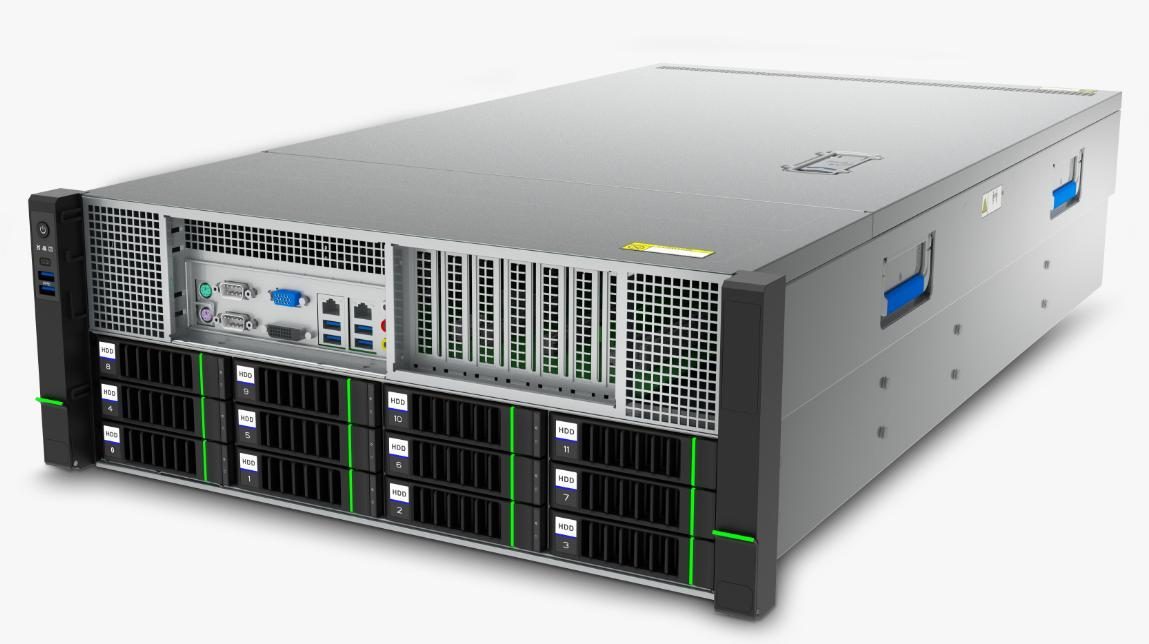
The same eight full-height dual-slot GPUs fit in both 4U and 7U chassis, but the mounting method, thermal behavior, and rack footprint are entirely different. A three-dimension comparison across installation, cooling and noise, and rack utilization.
A 4U chassis and a 7U chassis can both hold eight full-height dual-slot GPU cards, yet the mounting method, thermal behavior, and rack footprint are completely different. Teams that compare only on price often discover after delivery that a card does not fit, the airflow cannot keep up, or the rack is too shallow. This article breaks the two form factors apart.
【Mounting: riser adapters vs. direct insertion】
Inside a 4U enclosure there is little vertical room, so GPUs are usually mounted flat through PCIe riser adapters: the motherboard slot turns 90 degrees, cards lie horizontally with fans facing up or down, and spacing between cards is tight. The benefit is a short chassis and high rack density; the constraint is that card length and thickness both need checking, especially with dual-slot coolers that can crowd the fan shroud.
A 7U enclosure has room to spare. GPUs can plug directly into PCIe slots vertically, or sit horizontally with generous spacing. Wide air channels between cards accommodate larger coolers and are friendlier to 700W-class cards. Take the CR712-930-G as an example: its eight-GPU layout with large intake mesh shows noticeably lower airflow resistance than a same-density 4U build.
【Cooling and noise】
Compressing eight cards into a short 4U body raises flow resistance and heat density. Fans must spin faster to move the heat, and full-load noise is higher. That is fine in a dedicated server room with acoustic separation; in an office or near-field deployment it deserves a second thought.
A 7U chassis has space, lower resistance, and slower fans. Temperatures and noise stay flatter under sustained full load, which suits 24/7 training runs and on-premise inference gateways.
【Rack and operations perspective】
The 4U advantage is density: a 42U rack holds ten 4U machines but only six 7U machines. For GPU rental or cluster-expansion projects, rack space and power provisioning are real costs.
The 7U buys maintenance convenience: the larger interior makes card swaps, fan replacement, and cable management unhurried, and front-service designs mean routine checks happen without sliding the chassis out on rails.
【How to choose】
One sentence: for rack density with mid-to-low GPU power in a dedicated room, choose 4U (such as the CR404-780-GS). For high-power cards, sustained load, and easy maintenance, choose 7U (such as the CR712-930-G). Once your GPU model and count are fixed, send us the card length, thickness, and TDP — we will verify mounting and airflow before proposing the full system.